
Asking to cancel a solar contract does not automatically hurt your credit. Requesting a contract review, filing a complaint, disputing a billing error, seeking a buyout, or negotiating a transfer is not the same as missing a required payment.
The credit risk usually begins when the homeowner stops paying before the agreement has been formally cancelled, settled, paid off, transferred, or otherwise resolved.
Late payments, default, collection activity, and unpaid balances may be reported. Inaccurate reporting can also cause damage when it is not identified and disputed promptly.
The direct answer: Getting out of a solar contract will not necessarily hurt your credit. The result depends on how the agreement is resolved, whether required payments remain current, what the lender or provider reports, and whether any disputed information is accurate.
Do not stop automatic payments simply because you submitted a contract for review or told the solar company that you want out.
The safest approach is to identify the current payment obligation, continue monitoring the account, obtain every resolution in writing, and verify how the account is reported afterward.
Start with the complete guide to getting out of a solar contract in Colorado when the credit concern is part of a broader contract-cancellation problem.
Does Asking to Cancel a Solar Contract Hurt Your Credit?
Not by itself.
These actions do not automatically create a late payment or collection account:
- Requesting a copy of the contract
- Submitting the agreement for review
- Asking the company to cancel
- Sending a written billing dispute
- Filing a complaint with a regulator
- Requesting a payoff or buyout quote
- Starting a lease-transfer process
- Requesting repair or warranty service
- Negotiating a settlement
The account can still be affected by what happens during and after those actions.
For example, a homeowner may request cancellation while the lender continues to treat the loan as active. If the homeowner stops paying without a written cancellation or payment agreement, the lender may report the account as late.
A Complaint Does Not Automatically Pause the Contract
Filing a complaint with the solar company, Colorado Attorney General, Consumer Financial Protection Bureau, or another agency does not automatically:
- Cancel the agreement
- Pause the payment schedule
- Prevent late fees
- Stop credit reporting
- Stop collection activity by the original creditor
- Extend a contract deadline
The homeowner needs a separate written agreement, legal right, court order, or other documented basis before assuming the payment obligation has changed.
The Type of Solar Agreement Changes the Credit Risk
| Agreement Type | Possible Credit Connection | What to Review |
|---|---|---|
| Solar loan | The lender or servicer may report payment history, delinquency, default, balance, or account status | Promissory note, payment schedule, credit-reporting language, default terms, and servicing history |
| Solar lease | Regular payment reporting varies, but unpaid amounts may be referred for collection or otherwise reported | Lease payment terms, default provisions, collection rights, and credit authorization |
| Power purchase agreement | Regular reporting varies, but unpaid service invoices can lead to default or collection activity | PPA billing, default, termination, collection, and transfer terms |
| Cash purchase with unpaid installer balance | An unpaid contract balance may be collected or litigated even without a traditional solar loan | Payment milestones, invoices, completion disputes, and collection notices |
| Home-equity financing | The obligation may be secured by the home and reported as a mortgage or home-equity account | Loan documents, lien, payment status, and lender requirements |
Do Not Assume the Installer Controls the Loan
A homeowner may have:
- A sales agreement with one company
- An installation agreement with another company
- A loan originated by a bank
- A loan serviced by a separate finance company
- An account later assigned to another owner
The installer agreeing to review a complaint does not necessarily change what the lender expects.
Identify every company and send important notices to the correct party.
How Different Solar Contract Resolutions May Affect Credit
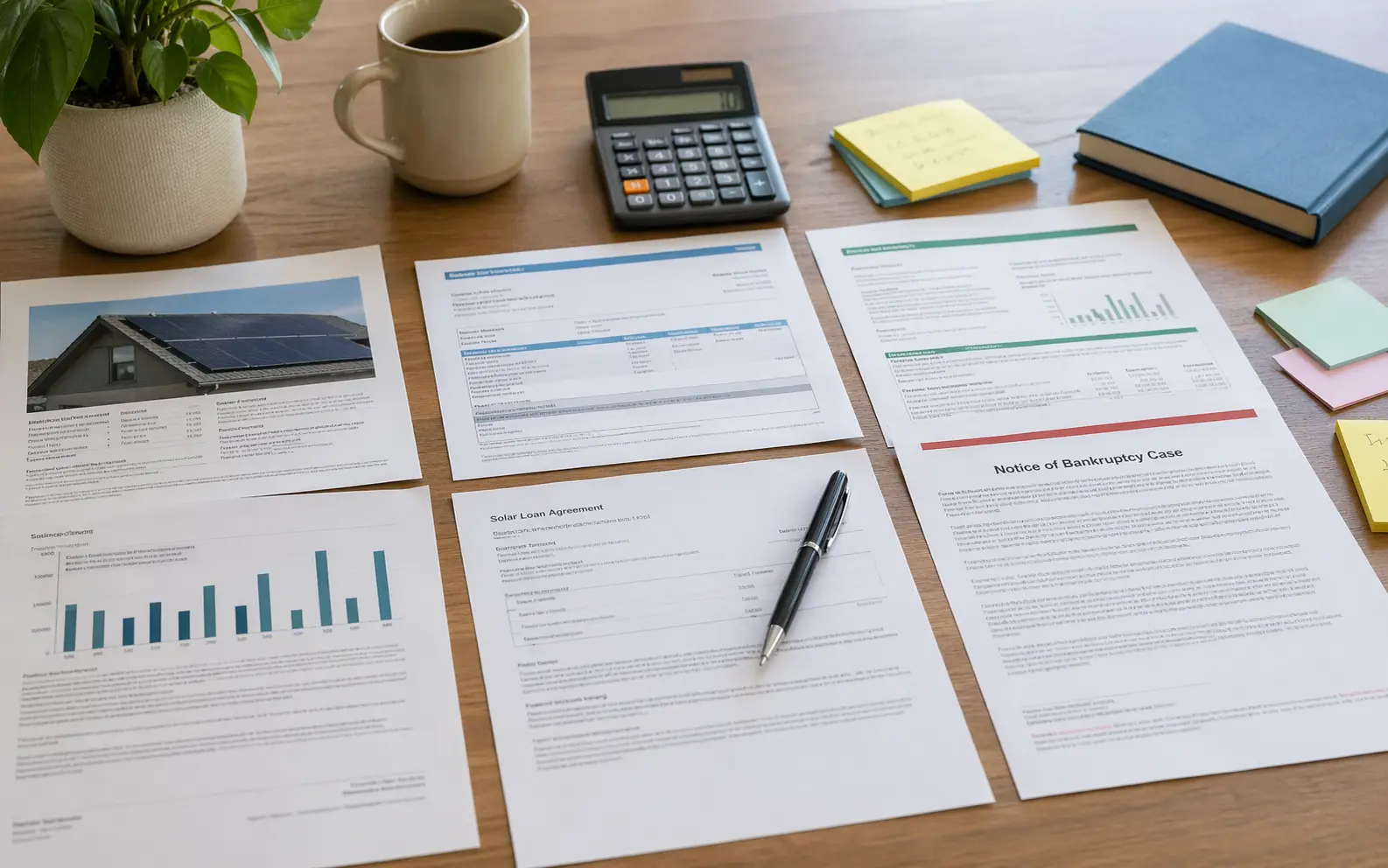
“Getting out” can describe several very different outcomes.
Cancellation Before the Loan Is Funded
When the sales and financing agreements are properly cancelled before funding, there may be no active loan balance to report.
Confirm in writing that:
- The installation agreement was cancelled
- The financing agreement was cancelled
- No funds were disbursed
- No payment is due
- The lender closed or withdrew the account appropriately
A credit inquiry associated with the application may still appear, depending on how the financing application was processed.
Cancellation After Funding
Once a lender has paid the installer or established an active account, the financing does not necessarily disappear because the homeowner cancelled or disputed the installation contract.
The parties may need to determine:
- Whether the lender will reverse the disbursement
- Whether the installer must return funds
- Whether the homeowner remains liable
- How the account will be closed and reported
- Whether equipment must be removed
Do not assume a verbal cancellation with the salesperson resolved the separate loan.
Full Loan Payoff
Paying the valid payoff amount generally satisfies the loan obligation.
Confirm that the lender reports:
- A zero balance
- The correct paid or closed status
- No late payment that did not occur
- The correct payoff date
Also request any required UCC termination or equipment release.
Lease or PPA Transfer
A completed transfer can release the seller from future payment responsibility when the provider approves the buyer and updates the account.
Confirm:
- The effective transfer date
- The seller’s final invoice
- The buyer’s assumption
- The seller’s written release
- The account status after transfer
Do not stop paying simply because the home is under contract or the buyer submitted transfer paperwork.
System Buyout or Prepayment
A buyout may transfer equipment ownership. A prepayment may pay future service charges while the provider continues to own the system.
Confirm how the account will be reported and whether any remaining balance, fee, or obligation survives.
Negotiated Settlement
A settlement may resolve the contract for:
- The full balance
- A reduced amount
- A payment plan
- A combination of payment and equipment return
- Another negotiated result
The written settlement should state:
- The exact amount due
- The payment deadline
- Whether the amount fully resolves the obligation
- How the account will be reported
- Whether collections will stop
- Whether the company will release a UCC filing
- Whether any claims are being released
Do not rely on a verbal promise that the company will “remove it from your credit.”
What Happens If You Stop Paying the Solar Contract?
Stopping payment is the action most likely to create a credit problem.
Depending on the agreement, the company may:
- Charge late fees
- Report the account as delinquent
- Declare a default
- Accelerate the balance
- Refer the account to a debt collector
- File a lawsuit
- Exercise rights involving the solar equipment
- Refuse a home-sale transfer or service request
A Valid Dispute Does Not Necessarily Suspend Payment
A homeowner may have a legitimate complaint involving:
- Misleading sales claims
- An unauthorized signature
- An inflated loan balance
- A payment that increased unexpectedly
- An unfinished installation
- A system that never received permission to operate
- A closed or unresponsive installer
Those facts may be important, but they do not automatically change the lender’s current account records.
Read The Solar Salesperson Lied to Me: What Are My Rights in Colorado? when the payment dispute began with a misleading sales presentation.
Contact the Lender Before the Payment Becomes Late
When making the scheduled payment has become difficult, ask the lender or servicer whether any documented options are available, such as:
- A payment plan
- A temporary deferment
- Forbearance
- A due-date adjustment
- A loan modification
- A re-amortization
- A settlement review
Availability varies, and requesting assistance does not guarantee it will be approved.
An Increased Payment Can Create a Sudden Default Risk
Some solar loans increase after an anticipated principal payment is not made. A homeowner may make every introductory payment on time and then be unable to afford the re-amortized amount.
Read Why Did My Solar Payment Suddenly Jump? to identify re-amortization, escalators, PPA billing, added fees, and servicing errors.
Does Disputing the Solar Account Protect Your Credit?
A dispute creates a formal record. It does not automatically eliminate the account or prevent all negative reporting.
Disputing With the Lender or Provider
A direct written dispute should identify:
- The account number
- The specific amount or status disputed
- Why the information is wrong
- The supporting documents
- The correction requested
- The requested response date
Keep proof that the company received it.
Disputing With a Credit Reporting Company
When you dispute information with a credit reporting company, the account may be marked as disputed while the investigation is pending.
The Consumer Financial Protection Bureau explains that disputed debt can remain visible on the report. A lender reviewing a new application may also delay or decline to extend credit while a significant dispute is unresolved.
A dispute notation does not prove that:
- The balance is invalid
- The account will be deleted
- The lender must stop billing
- The underlying contract ended
- The homeowner no longer owes payment
Accurate Negative Information Is Not Automatically Removable
If a late payment, default, or settlement is accurate and current, a credit reporting company generally does not have to delete it simply because the homeowner disputes the solar sale.
Be cautious of anyone promising to remove every negative item, regardless of accuracy.
The Federal Trade Commission warns that companies cannot legally remove accurate, up-to-date negative information merely by repeatedly disputing it.
What If the Solar Account Goes to Collections?
Do not ignore a collection notice.
A debt collector generally must provide validation information, including:
- The debt collector’s name
- The creditor’s name
- The account number, when applicable
- An itemization of the amount
- The current balance
- Information about disputing the debt
- The end date of the validation period
The 30-Day Validation Period
When a consumer sends a written dispute within the applicable 30-day validation period, the debt collector generally must pause collection of the disputed amount until it provides verification.
This debt-collection protection does not necessarily:
- Cancel the debt
- Remove prior accurate credit reporting
- Change the original contract
- Prevent the collector from resuming after verification
- Resolve a dispute with the original creditor
Review the official CFPB debt-validation guidance.
Request the Original Creditor Information
A solar debt may have moved through:
- The originating bank
- A solar finance company
- A loan servicer
- An account purchaser
- A collection agency
- A law firm
Request documentation showing:
- The original creditor
- The current owner of the account
- The assignment history
- The original contract
- The complete account balance calculation
- The collector’s authority
Common Solar Credit-Reporting Errors
Review all three credit reports for:
- An account that does not belong to you
- A signature or loan you did not authorize
- A closed account reported as open
- An active account reported as closed
- A current account reported as late
- An incorrect balance
- An incorrect payment amount
- An incorrect date of first delinquency
- The same account reported twice
- A transferred account reported with two active balances
- A paid account that still shows a balance
- A settlement that was not updated
- A cancelled account reported as defaulted
- A payment applied to the wrong account
Servicing Transfers Can Create Duplicate or Incorrect Reporting
When a solar account transfers, the former servicer may report the account as closed while the new servicer reports the remaining balance.
That is not automatically an error.
The problem arises when:
- Both companies report the full debt as currently due
- The prior servicer reports late payments after the transfer date
- The new servicer omits payments made during the transition
- The balance changes without explanation
- The homeowner was given incorrect payment instructions

Unauthorized Solar Accounts
When a homeowner believes another person signed the agreement, used an email account without authorization, or controlled the electronic signature process, preserve:
- The electronic-signature audit trail
- Signature timestamps
- Email delivery records
- Telephone numbers
- Device or identity-verification information
- The salesperson’s communications
- The complete loan application
- Credit-inquiry records
An unauthorized account may require prompt credit-report disputes, identity-theft procedures, complaints, and qualified legal guidance.
How to Dispute a Solar Account Error on Your Credit Report
1. Obtain All Three Credit Reports
Use AnnualCreditReport.com to obtain reports from Equifax, Experian, and TransUnion.
Requesting your own credit reports does not hurt your credit score.
2. Identify Every Incorrect Entry
For each bureau, record:
- The company reporting the account
- The account number
- The reported status
- The reported balance
- The payment history
- The exact information you believe is wrong
3. Dispute With the Credit Reporting Company
The Consumer Financial Protection Bureau recommends explaining in writing:
- What is wrong
- Why it is wrong
- Which correction you want
- Which documents support your position
Send copies rather than original documents.
When mailing a dispute, consider using a trackable delivery method and keep the receipt.
4. Dispute With the Furnisher
The furnisher is the company that provided the account information to the credit reporting company.
It may be:
- The solar lender
- The loan servicer
- The lease or PPA provider
- A debt collector
- An account purchaser
Send the furnisher the same clear explanation and supporting documents.
5. Track the Investigation
Keep:
- The dispute confirmation
- The date submitted
- Proof of delivery
- The supporting documents
- The investigation result
- The updated credit report
- Every company response
6. Review All Three Reports Again
A correction by one credit bureau does not necessarily correct the other two.
Confirm that every bureau reporting the account has updated:
- The balance
- The payment history
- The account status
- The ownership
- The dispute notation
Review the CFPB’s credit-report dispute instructions.
How Can a Solar Settlement or Payoff Affect Credit?
Paid in Full
A full payoff should generally result in a zero balance and an appropriate paid or closed status.
A prior accurate late-payment history may remain even after payoff.
Settlement for Less Than the Full Balance
A creditor may agree to accept less than the claimed balance.
The account may be reported as:
- Settled
- Paid for less than the full balance
- Closed after settlement
- Another accurate status used by the furnisher
How that status affects a particular score or future credit decision can vary by scoring model, lender, timing, and the rest of the credit file.
Deletion Is Not Guaranteed
A creditor or collector may refuse to delete accurate account history as part of a settlement.
Do not make payment based solely on an oral promise about credit reporting.
The written settlement should specify:
- The amount accepted
- The deadline
- The remaining balance after payment
- The account status to be reported
- Whether collection activity will stop
- Whether a lawsuit will be dismissed
- Whether UCC or equipment interests will be released
Loan Modification
A modification can change:
- The monthly payment
- The due date
- The loan term
- The interest calculation
- The principal balance
- The account reporting
Confirm whether the account will be treated as current after the modification and whether prior late history remains.
Credit Risks During a Home Sale or Refinance
A home sale or refinance can expose solar account problems that were previously unnoticed.
The buyer’s or homeowner’s mortgage lender may review:
- The solar payment
- The current balance
- The credit report
- The solar agreement
- The UCC filing
- The transfer or payoff requirement
- Any delinquency or collection account
Do Not Stop Paying Because the Home Is Under Contract
The seller generally remains responsible until the solar provider completes the transfer, payoff, purchase, prepayment, or another written resolution.
A late solar payment before closing can:
- Delay transfer approval
- Change the payoff amount
- Create a new credit issue
- Concern the buyer’s lender
- Reduce the seller’s net proceeds
- Delay or derail closing
Read Selling Your Colorado Home With a Solar Lease.
A UCC Filing Is a Separate Issue
A UCC filing is not necessarily a consumer credit tradeline. The underlying loan, lease, PPA, payoff, and payment history may still affect the transaction.
Read What Is a UCC-1 Solar Lien? for guidance about filing searches, releases, subordinations, and terminations.
What If the Solar Lender or Servicer Changes?
A servicing transfer does not automatically cancel the loan.
The new servicer may take over:
- Payment collection
- Account statements
- Customer support
- Credit reporting
- Payoff requests
- Default administration
Save:
- The transfer notice
- The effective date
- The former and new account numbers
- The final statement from the old servicer
- The first statement from the new servicer
- Proof of payments made during the transition
- Automatic-payment instructions
Confirm Where Payments Must Be Sent
Do not send money based on an unverified email or telephone call.
Confirm the transfer through:
- The prior servicer’s official notice
- The new servicer’s official website
- The telephone number on a verified statement
- The lender’s official customer portal
The Installer’s Bankruptcy May Not End the Loan
The installer may close while the lender, account owner, or servicer continues collecting payments.
The continuing loan and the lost installation or warranty service must be reviewed separately.
Read Your Solar Company Went Bankrupt and a Servicer Took Over: Is Your Warranty Still Valid?.
How to Protect Your Credit During a Solar Contract Dispute
1. Identify Every Active Obligation
Make a list of:
- The solar sales agreement
- The installation contract
- The loan
- The lease or PPA
- The battery agreement
- Any separate home-improvement financing
- Any collection account
2. Confirm the Current Payment Status
Ask each lender, servicer, or provider to confirm:
- The amount currently due
- The due date
- Whether the account is current
- Whether any fee has been added
- Whether a payment change is scheduled
- Where payments must be sent
3. Keep Payments Documented
Save:
- Bank records
- Payment confirmations
- Automatic-payment screenshots
- Statements
- Cancelled checks
- Receipts
4. Put Every Dispute in Writing
A written dispute should explain:
- What happened
- Which amount or status is disputed
- Which documents support the dispute
- What correction or resolution is requested
5. Monitor All Three Credit Reports
Check for:
- New late payments
- New collection accounts
- Duplicate balances
- Incorrect account status
- Incorrect payoff reporting
- Unauthorized inquiries or accounts
6. Obtain Every Resolution in Writing
The final document should identify:
- The agreement being resolved
- The amount paid or cancelled
- The effective date
- The remaining balance
- The future payment obligation
- The agreed account reporting
- The release of any UCC or equipment interest
7. Verify the Result Afterward
After cancellation, transfer, payoff, or settlement:
- Review the final statement
- Review all three credit reports
- Check the UCC records when applicable
- Confirm automatic payments stopped at the correct time
- Keep the resolution documents permanently
8. Submit the Complete File for Review
Use the Solar Exit Colorado Contract Review to submit the agreement, loan or lease documents, payment history, credit notices, collection letters, disputes, and company responses.
Where Can You File a Solar Credit or Lending Complaint?
Colorado Consumer Credit Unit
The Colorado Attorney General’s Consumer Credit Unit investigates complaints involving lenders and creditors regulated under the Colorado Uniform Consumer Credit Code.
The office asks consumers to include the loan agreement and correspondence with the business.
Review the Colorado consumer-credit complaint process.
Consumer Financial Protection Bureau
The CFPB accepts complaints involving:
- Consumer loans
- Loan servicing
- Debt collection
- Credit reporting
- Incorrect account information
For a complaint about inaccurate or incomplete credit-report information, the CFPB currently requires the consumer to dispute the information directly with the credit reporting company first.
The CFPB complaint notice instructs consumers not to submit the credit-report complaint while that dispute remains pending or before the required period has passed.
Use the Consumer Financial Protection Bureau complaint system.
Colorado Attorney General Product and Service Complaint
A separate product and service complaint may be appropriate when the issue involves misleading solar sales claims, false promises, incorrect billing, or failure to perform.
Review the Colorado product and service complaint process.
Federal Trade Commission
Report suspected credit-repair scams, false identity-theft schemes, or companies promising to remove accurate negative information through ReportFraud.ftc.gov.
The Colorado Solar Resources directory lists additional agencies and public records.
Common Mistakes to Avoid
- Stopping payments immediately after requesting cancellation
- Assuming the installer controls the lender’s account
- Assuming a complaint pauses credit reporting
- Ignoring a collection validation notice
- Disputing accurate information simply to try to remove it
- Filing a false identity-theft report
- Paying a company that guarantees deletion of accurate negative items
- Saving only the current statement instead of the full payment history
- Failing to review all three credit reports
- Disputing only with the credit bureau and not the furnisher
- Assuming a paid balance automatically updates every report
- Relying on a verbal settlement or reporting promise
- Stopping payments during a home-sale transfer
- Ignoring notices from a new loan servicer
- Throwing away payoff, settlement, or account-release documents
Frequently Asked Questions
Will asking to cancel my solar contract lower my credit score?
Not by itself. Asking to cancel, requesting a review, or filing a complaint is different from missing a required payment.
Will submitting my solar contract for review hurt my credit?
No. Submitting documents for review does not itself change the loan account or create a credit-report entry.
Can I stop paying while my solar contract is being reviewed?
Not based solely on the fact that a review is underway. The current agreement and account generally remain active until a written resolution or other applicable authority changes the obligation.
What happens if I stop paying the solar loan?
The lender may charge fees, report delinquency, declare default, refer the balance for collection, or take other action allowed by the agreement and applicable law.
Does disputing the loan stop credit reporting?
Not automatically. A dispute may be noted and investigated, but the account can remain on the credit report. Accurate negative information may continue to be reported.
Can a solar company report me late while I dispute the contract?
The answer depends on the account status, dispute, reporting accuracy, and applicable requirements. A dispute alone does not necessarily suspend the scheduled payment.
Can inaccurate solar-loan information be corrected?
Yes. Dispute inaccurate information with each credit reporting company that shows the error and with the lender, servicer, collector, or other company that furnished it.
Can accurate late payments be removed?
Generally, accurate and current negative information cannot be removed simply because it hurts the consumer’s credit. Be cautious of companies guaranteeing otherwise.
Will paying off the solar loan remove prior late payments?
Not necessarily. The account should show a zero balance and appropriate paid status, but accurate prior delinquencies may remain for the applicable reporting period.
Will settling for less than the balance hurt my credit?
A reduced settlement may be reported as settled or paid for less than the full balance. Its effect varies by scoring model, lender, timing, and the rest of the credit file.
Does transferring a solar lease to the buyer hurt my credit?
A properly completed transfer should not create a delinquency merely because the agreement changed hands. Continue payments until the provider confirms the transfer and seller’s release.
Does a solar UCC-1 filing appear on my consumer credit report?
A UCC filing and a consumer credit tradeline are different records. The underlying solar loan, payment history, collection account, or default may still appear on a consumer credit report.
What if the solar loan does not belong to me?
Request the complete loan application and electronic-signature records. Dispute the account promptly with the credit reporting companies and furnisher, and follow appropriate identity-theft procedures when the facts support them.
Should I hire a credit repair company?
Consumers can dispute inaccurate information directly at no cost. Avoid companies that promise to remove accurate information, demand upfront fees, or instruct you to submit false disputes or identity-theft reports.
The Bottom Line
Getting out of a solar contract does not automatically damage credit.
The credit outcome depends largely on:
- Whether the account remained current
- How the contract was resolved
- Whether a balance remained
- Whether the account went into default or collections
- What the lender, provider, or collector reported
- Whether inaccurate information was disputed and corrected
The most dangerous assumption is that requesting cancellation, disputing the sale, or filing a complaint automatically pauses the payment obligation.
Before changing payments:
- Review the complete agreement
- Confirm the account status
- Identify every company involved
- Document the dispute
- Monitor all three credit reports
- Obtain every resolution in writing
Submit the complete contract, payment history, credit notices, collection letters, and disputes through the Solar Exit Colorado Contract Review when you are ready to identify what the documents may support.
Related Colorado Solar Guides
- How to Get Out of a Solar Contract in Colorado: 2026 Complete Guide
- How to Cancel a Sunrun Solar Lease in Colorado
- How to Cancel a Tesla Solar Contract in Colorado, Including SolarCity Leases
- The Solar Salesperson Lied to Me: What Are My Rights in Colorado?
- Hidden Solar Dealer Fees and the Tax-Credit Trap
- Why Did My Solar Payment Suddenly Jump?
- Selling Your Colorado Home With a Solar Lease
- What Is a UCC-1 Solar Lien?
- Your Solar Company Went Bankrupt and a Servicer Took Over
Official Sources Used in This Guide
- Consumer Financial Protection Bureau: Solar Financing Issue Spotlight
- Consumer Financial Protection Bureau: Personal Installment Loans
- Consumer Financial Protection Bureau: Disputing Credit-Report Errors
- Consumer Financial Protection Bureau: Common Credit-Report Errors
- Consumer Financial Protection Bureau: Disputed Debt and Credit Reports
- Consumer Financial Protection Bureau: Debt Validation Information
- Consumer Financial Protection Bureau: Credit-Reporting Complaint Notice
- Federal Trade Commission: Spot Credit-Repair Scams
- Colorado Attorney General: Consumer Credit Complaints
- AnnualCreditReport.com: Free Credit Reports
This article provides general educational information and is not legal, financial, credit, debt-relief, tax, mortgage, real estate, or accounting advice. Requesting cancellation or disputing an account does not automatically suspend a payment obligation or prevent credit reporting. Credit effects depend on the agreement, account status, reporting accuracy, resolution, and applicable law. Solar Exit Colorado is not a law firm or credit repair organization.