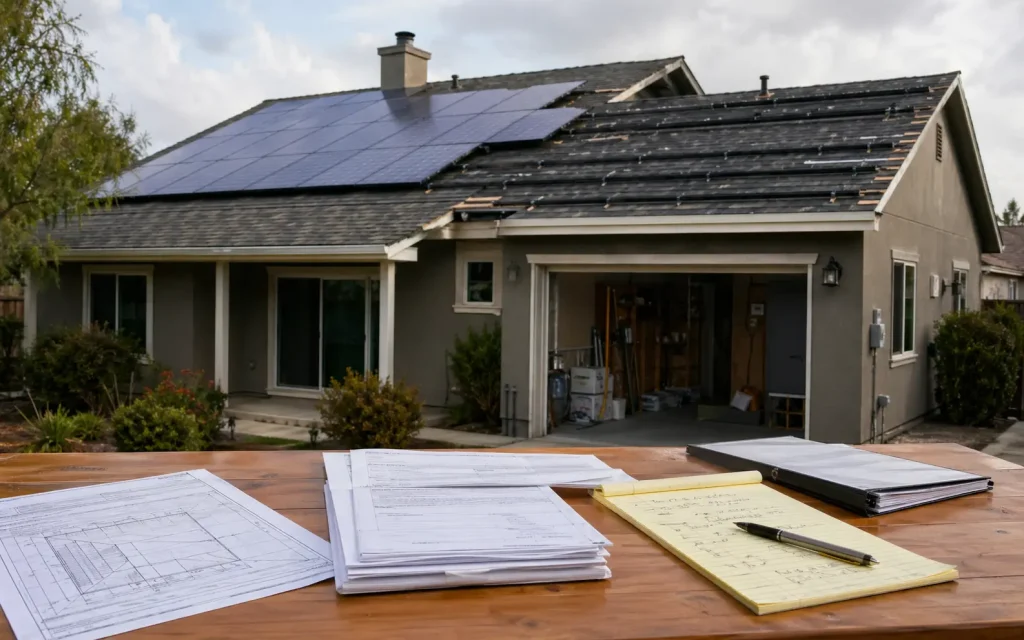

When a solar company goes bankrupt, homeowners are often left with two problems that seem to contradict each other.
The company that sold or installed the system may no longer answer the phone, provide repairs, complete the installation, or honor its warranty. At the same time, another company may continue sending payment statements and demanding that the solar loan, lease, or power purchase agreement remain current.
Both things can happen because the installer, lender, account owner, servicer, equipment manufacturer, and warranty provider may be separate companies.
The direct answer: A solar company’s bankruptcy does not automatically cancel a separate loan, lease, or PPA. It also does not automatically eliminate every equipment warranty. The homeowner must identify which company failed, who now owns or services the account, which warranties were issued by separate companies, and what the bankruptcy records say.
A new servicer collecting payments does not necessarily mean that the new company agreed to repair the system or honor the original installer’s workmanship warranty.
Do not stop payments, send money to an unverified company, hire someone to alter the system, or assume that every warranty disappeared before reviewing the complete transaction.
Start with the complete guide to getting out of a solar contract in Colorado when the bankruptcy is part of a larger cancellation, financing, or contract-exit problem.
Does a Solar Company’s Bankruptcy Cancel the Contract?
Not automatically.
The effect depends on:
- Which company filed bankruptcy
- Which company signed each agreement
- Who owns the solar equipment
- Who funded the transaction
- Who currently owns the loan or payment obligation
- Who services the account
- Whether the contract was assigned or sold
- What the bankruptcy court authorizes
- Whether another company assumes specific obligations
The Installer and Lender May Be Separate
A common financed solar transaction includes:
- A salesperson or lead-generation company
- A solar sales company
- An installation contractor
- An electrical contractor
- An originating bank or finance company
- A loan owner
- A payment servicer
- Panel, inverter, and battery manufacturers
- A warranty or service administrator
The installer may receive payment from a lender shortly after installation or another contract milestone.
If the installer later fails, the lender may still claim that the homeowner owes the separately documented loan.
A Lease or PPA May Have a Separate System Owner
Under a solar lease or PPA, the company that marketed or installed the system may not be the legal owner of the equipment.
The system may be owned by:
- A national solar provider
- An affiliated financing entity
- A special-purpose company
- An investment fund
- A later purchaser of the solar portfolio
The system owner may hire another company to collect payments, monitor systems, coordinate service, or manage transfers.
The bankruptcy of the original installer does not necessarily end the lease or PPA owned by another entity.
The Bankruptcy Court May Approve a Sale or Assignment
Assets involved in a bankruptcy can include:
- Customer contracts
- Loan receivables
- Lease and PPA portfolios
- Equipment ownership interests
- Service operations
- Intellectual property and customer records
Another company may purchase or assume some assets without assuming every warranty, service promise, installation obligation, or disputed customer claim.
The court orders, sale documents, assignment records, and customer notices need to be reviewed.
Identify Which Company Actually Failed
Do not refer to every participant simply as “the solar company.”
Create a separate entry for every business connected to the transaction.
| Company Role | Typical Responsibility | What to Verify |
|---|---|---|
| Sales company | Advertising, proposal, sales representations, and contract presentation | Legal entity, salesperson relationship, and agreement signed |
| Installer | Permits, construction, electrical work, inspection, and activation | Contractor name, license, project status, and workmanship warranty |
| Lender | Provides or owns financing used to purchase the system | Promissory note, current owner, balance, and security interest |
| Loan servicer | Sends statements, receives payments, tracks balances, and handles account administration | Authority, transfer date, payment history, and contact information |
| Lease or PPA owner | Owns the equipment and contractual payment stream | Legal owner, transfer rights, service obligations, and UCC records |
| Equipment manufacturer | Issues product warranties for panels, inverters, batteries, or other components | Manufacturer, model, serial number, warranty registration, and claim process |
| Warranty administrator | Processes or coordinates specific warranty or service claims | Who issued the coverage and whether administration transferred |
| Monitoring provider | Provides online production data or system alerts | Account ownership, login access, hardware compatibility, and fees |
Use the Exact Legal Names
A brand name may differ from the entity named in the contract.
Record:
- The name on the proposal
- The name on the installation agreement
- The name on the financing documents
- The name receiving payments
- The name shown on permits
- The name shown on the UCC filing
- The name shown on warranty documents
- Every successor, assignee, or servicing company
This separation helps determine which obligations may remain and which company should receive each request or complaint.
Did the Company File Bankruptcy, Close, Dissolve, or Just Stop Responding?
These are not the same event.
Bankruptcy
A formal bankruptcy is a federal court proceeding.
The court record may identify:
- The debtor’s legal name
- The bankruptcy chapter
- The filing date
- The case number
- The court
- The trustee or debtor’s counsel
- Scheduled assets and liabilities
- Contract assumptions or rejections
- Asset-sale motions
- Claim deadlines
- Confirmed plans or dismissal orders
Business Dissolution or Delinquency
A state business record may show that an entity is:
- In good standing
- Delinquent
- Voluntarily dissolved
- Administratively dissolved
- Withdrawn
- Converted or merged
A state business status does not by itself prove that the company filed bankruptcy, has no assets, or no longer has legal obligations.
Operational Closure
A business may stop answering phones, lay off employees, abandon its office, or stop accepting new customers without immediately filing bankruptcy or dissolving its entity.
Look for objective records rather than relying only on:
- A disconnected telephone number
- A closed office
- Social-media posts
- Online reviews
- A salesperson’s statement
- A notice from an unfamiliar servicer
Why Did a New Solar Servicer Take Over?
A servicer is generally the company responsible for administering the account.
It may:
- Send monthly statements
- Accept payments
- Maintain the account balance
- Apply principal and interest
- Issue payoff statements
- Handle payment questions
- Report account information when authorized
- Manage collections or defaults
The servicer may not:
- Own the loan
- Own the solar equipment
- Have installed the system
- Provide technical repairs
- Honor the installer’s workmanship warranty
- Control the manufacturer’s warranty
- Have authority to cancel the sales agreement
The transfer can occur because:
- The original servicer sold or transferred servicing rights
- The lender hired a new account administrator
- A solar portfolio was sold
- A bankruptcy purchaser acquired customer accounts
- The original company ceased operations
- An affiliate or successor began managing the accounts

A Servicing Transfer Does Not Explain the Warranty
A payment notice may say nothing about:
- Who will repair the system
- Who will complete unfinished work
- Who will honor roof coverage
- Who will process manufacturer claims
- Who will restore monitoring access
- Who will handle a home-sale transfer
Send separate written questions about payment servicing and technical service.
How to Verify the New Servicer
Do not send payment or personal information based solely on an unexpected email, telephone call, or letter.
Compare the Notice With Existing Records
Verify:
- The homeowner’s name
- The property address
- The original account number
- The new account number
- The lender or system owner
- The claimed transfer date
- The current balance
- The required payment
- The payment address
Contact the Prior Company Through a Verified Channel
Use:
- The telephone number on a prior statement
- The official customer portal
- The official company website
- A prior verified email address
- The lender identified in the signed agreement
Ask whether the account was assigned or transferred to the named servicer.
Request Proof of Authority
Ask the new servicer to provide:
- The legal name of the account owner
- The legal name of the servicer
- The effective date of transfer
- The account balance
- The complete payment history
- The source of its authority to collect
- The address for written disputes
- The process for requesting payoff or ownership information
- The company responsible for service and warranties
Check Business and Court Records
Search:
- The Colorado Secretary of State business database
- The company’s formation-state records
- PACER bankruptcy records
- UCC records
- Notices filed in the known bankruptcy case
A business database confirms filed records. It does not prove that the company has the authority claimed in a specific customer account.
Do You Still Have to Make Solar Payments After the Company Goes Bankrupt?
Possibly.
The answer depends on which company failed and which agreement created the payment obligation.
Separate Solar Loan
When a separate lender funded the system, the lender or account owner may continue to require payment even though the installer stopped operating.
Review:
- The promissory note
- The loan agreement
- The lender’s disbursement
- The payment history
- The servicing transfer
- The current account owner
- Any rights connected to installer performance
Lease or PPA
A lease or PPA payment may continue when the system owner survives, the contract was assigned, or a portfolio purchaser acquired the agreement.
The continued payment obligation and the company’s continued service obligations should both be reviewed.
Installer Payment Plan
If the failed installer itself financed the purchase or accepted installment payments, the bankruptcy case may affect who owns and collects the receivable.
Request written instructions and verify them against the bankruptcy docket or authorized notices.
Do Not Assume Service Failure Automatically Suspends Payment
A system that is unfinished, offline, damaged, or unsupported may create a serious dispute.
It does not automatically mean that every separate lender or contract party recognizes the account as suspended.
Before stopping payment, review:
- The agreement
- The account status
- The default provisions
- Written company responses
- Any bankruptcy or court order
- Appropriate professional guidance
Read Will Getting Out of My Solar Contract Hurt My Credit? before changing payments based only on the installer’s closure.
Review Unexpected Payment Changes
A servicing transfer should not be accepted as a complete explanation for an unexplained increase.
Request the contract provision and calculation supporting any change.
Read Why Did My Solar Payment Suddenly Jump?.
Is the Solar Warranty Still Valid After Bankruptcy?
Some warranty rights may remain. Others may become difficult or impossible to enforce against the company that issued them.
The word “warranty” can refer to several separate promises.
Determine:
- Who issued the warranty
- What it covers
- How long it lasts
- Whether it is transferable
- Whether registration was required
- Who administers claims
- Whether labor is included
- Whether another contractor can perform the work
- Whether the company issuing it still exists
- Whether another company assumed the obligation
Manufacturer Warranties May Be Separate
The manufacturer of the panels, inverter, optimizer, battery, or other equipment may have issued a separate written warranty.
The installer’s bankruptcy does not automatically terminate a warranty issued by an unrelated manufacturer.
The manufacturer may still require:
- Proof of purchase
- The installation date
- The model and serial number
- Diagnostic information
- Photographs
- An authorized technician’s evaluation
- Return of the defective equipment
The Workmanship Warranty Is Usually Different
A workmanship warranty may cover installation-related issues such as:
- Roof penetrations
- Flashing
- Racking installation
- Wiring
- Electrical connections
- Conduit placement
- Damage caused during installation
If the bankrupt installer issued that warranty directly, another company may not be obligated to honor it unless the obligation was assumed, transferred, insured, bonded, or otherwise preserved.
A Service Contract Is Not Necessarily a Product Warranty
A separate service or maintenance contract may cover:
- Inspections
- Monitoring
- Routine maintenance
- Labor
- Diagnostic visits
- Equipment replacement coordination
The service contract may have been issued by the installer, provider, third-party administrator, or another company.
Read the document to determine who is responsible for performance.

Build a Solar Warranty Map
| Coverage | Possible Issuer | What to Review |
|---|---|---|
| Panel product warranty | Panel manufacturer | Defects, exclusions, claim process, labor, shipping, and transfer |
| Panel performance warranty | Panel manufacturer | Degradation standard, testing, remedy, and measurement requirements |
| Inverter warranty | Inverter manufacturer | Parts, labor, diagnostic process, replacement, and authorized service |
| Battery warranty | Battery manufacturer | Capacity, cycles, operating requirements, connectivity, and replacement |
| Workmanship warranty | Installer | Installation defects, labor, roof penetrations, electrical work, and duration |
| Roof warranty | Installer, roofer, or separate provider | Leaks, affected areas, exclusions, notice requirements, and repair process |
| Production guarantee | Installer, lease owner, or PPA provider | Guaranteed amount, measurement period, exclusions, and compensation |
| Monitoring service | Installer, manufacturer, or software provider | Account access, fees, hardware ownership, data, and continued support |
| Maintenance obligation | Lease or PPA owner | Repair responsibility, response time, access rights, and remedies |
Check for Insurance, Bonds, or Third-Party Coverage
Review whether the installer had:
- A contractor license bond
- A performance bond
- A payment bond
- Liability insurance
- A warranty-insurance product
- A third-party service administrator
The existence and usefulness of those protections depend on the actual policy, bond, claim, dates, exclusions, and applicable requirements.
Do Not Assume a Successor Accepted Every Warranty
A company purchasing customer accounts may have acquired:
- The right to collect payments
- The equipment portfolio
- Customer data
- Monitoring systems
- Specific service contracts
It may not have assumed:
- The installer’s workmanship warranty
- Unresolved damage claims
- Promises made by salespeople
- Refund obligations
- Every pre-bankruptcy service request
Request the document or written explanation identifying which obligations were assumed.
How to Pursue a Manufacturer Warranty Without the Installer
1. Identify the Equipment
Record:
- Manufacturer
- Model number
- Serial number
- Installation date
- Location on the system
- Current error code or symptom
Equipment information may appear on:
- The proposal
- The system-design plan
- Permit documents
- Equipment labels
- The monitoring portal
- Invoices
- Warranty-registration emails
2. Obtain the Written Warranty
Do not rely only on a sales brochure saying the system had a “25-year warranty” or “full coverage.”
Review:
- What component is covered
- What failures are excluded
- Whether labor is covered
- Whether shipping is covered
- Whether an authorized installer must diagnose the issue
- Whether coverage transfers to a later homeowner
- The claim deadline and notice process
3. Contact the Manufacturer Directly
Provide:
- The homeowner’s information
- The property address
- The equipment information
- Proof of purchase or installation
- The system issue
- Monitoring data
- Photographs
- The original installer’s closure information
4. Ask Whether Another Contractor Can Complete the Claim
Request written confirmation of:
- Who may diagnose the equipment
- Whether the technician must be authorized
- How authorization is obtained
- Whether labor reimbursement is available
- Where replacement equipment will be shipped
- Who owns removed or replaced parts
5. Document the Existing Condition Before Work Begins
Save:
- Photographs
- Videos
- Error codes
- Production data
- Utility bills
- Technician reports
- Manufacturer communications
This documentation can be important when another contractor’s work could affect an existing claim or warranty.
What If the Installation Is Unfinished or the System Does Not Work?
An unfinished project can involve several separate problems:
- Missing equipment
- Incomplete electrical work
- An open permit
- A failed inspection
- Correction notices
- No utility interconnection approval
- No permission to operate
- A lender that already disbursed funds
- Payments that have already started
Confirm the Project Status
Request records from:
- The local building department
- The electrical inspection authority
- The electric utility
- The lender
- The equipment manufacturers
- The current system owner or servicer
Collect:
- The permit application
- The permit status
- Inspection results
- Correction notices
- The utility application
- Permission-to-operate records
- System monitoring data
- Payment and funding records
Do Not Hire Another Contractor Blindly
Before another company alters the project, determine:
- Who owns the equipment
- Who has authority to approve changes
- Whether the permit can be transferred
- Whether the utility application can be updated
- Whether manufacturer warranties require authorized work
- Whether the lender or lease owner must consent
- Whether another contractor will assume responsibility for existing work
An independent inspection can document the condition without necessarily authorizing immediate alteration.
Compare Funding With Completion
Request records showing:
- When the lender approved the loan
- When the lender disbursed funds
- Which completion certificate was used
- Who signed the completion certificate
- What work had actually been completed at that time
A funding dispute should be directed to the lender and servicer in writing.
Homeowners who believe the project or financing was misrepresented should read The Solar Salesperson Lied to Me: What Are My Rights in Colorado?.
Homeowners reviewing an inflated financed amount should also read Hidden Solar Dealer Fees and the Tax-Credit Trap.
How to Find the Solar Company’s Bankruptcy Case
Search PACER
PACER provides public electronic access to federal court records, including bankruptcy cases.
Use the PACER case-search system.
Search using:
- The company’s exact legal name
- Former company names
- Parent companies
- Affiliated entities named in the contract
- Names shown on servicing or assignment notices
Record the Case Information
Save:
- The debtor’s legal name
- The bankruptcy chapter
- The case number
- The court
- The filing date
- The trustee or debtor’s counsel
- The claims agent, when one exists
- The proof-of-claim deadline
Review the Docket
Potentially relevant filings may include:
- The bankruptcy petition
- Schedules of assets and liabilities
- Creditor notices
- Contract assumption or rejection motions
- Asset-sale motions
- Sale orders
- Assignment schedules
- Claims procedures
- Bar-date notices
- Confirmed plans
- Conversion or dismissal orders
Bankruptcy documents can be complicated. Obtain qualified bankruptcy or consumer-law guidance when the homeowner’s rights depend on the court record.
Do Not Assume Every Customer Will Receive Notice
The company may not have listed every homeowner correctly.
Addresses may also be outdated or incomplete.
Monitor the known case rather than relying entirely on mail delivery when a refund, warranty, damage, or incomplete-work claim may exist.
Should a Homeowner File a Proof of Claim?
A proof of claim is a written statement asserting a right to payment from the bankruptcy debtor.
A homeowner may believe a claim exists because of:
- An unreturned deposit
- Payments for uncompleted work
- Property damage
- Repair expenses
- A refund obligation
- A breached service contract
- A breached workmanship warranty
- Another claim that can be reduced to money
Whether a particular warranty, cancellation, damage, or service issue creates a valid bankruptcy claim is a legal question.
Check the Deadline
Bankruptcy claim deadlines vary based on the case and court notices.
The deadline is commonly called the claims bar date.
Review:
- The notice of bankruptcy
- The claims procedure order
- The bar-date notice
- The court docket
- The claims agent’s official website, when applicable
Do not assume the deadline is the same in every Chapter 7 or Chapter 11 case.
Use the Correct Debtor
A bankruptcy may involve several related companies.
The homeowner’s contract may be with one entity while the brand’s operating company, parent, installer, or affiliate filed a separate case.
Confirm:
- Which entity owes the alleged obligation
- Which entity appears on the contract
- Which bankruptcy case covers that entity
- Whether the cases are jointly administered
Preserve Supporting Documents
Potential documentation can include:
- The signed agreement
- Payment receipts
- Warranty documents
- Repair estimates
- Property-damage photographs
- Service requests
- Cancellation notices
- Refund promises
- Communications with the company
Review the official United States Courts Proof of Claim form.
Filing a proof of claim does not guarantee payment. Distribution depends on the case, available assets, claim status, priority, and court process.
How Can a Bankruptcy or Servicer Transfer Affect a Home Sale?
A homeowner may need cooperation from a company that no longer exists in its original form.
The transaction may require:
- A loan payoff
- A lease or PPA transfer
- A system purchase
- A prepayment quote
- A UCC release
- A subordination agreement
- A warranty transfer
- >A subordination agreement
- A warranty transfer
- Proof of equipment ownership
Identify Who Has Authority
The payment servicer may be able to issue a loan payoff but not approve a lease transfer.
A portfolio owner may approve a transfer but use another company for UCC documents.
A warranty administrator may handle equipment claims but have no authority over financing.
Request written identification of the company responsible for each action.
Follow UCC Assignments
A bankruptcy sale or account transfer may produce:
- A new secured party
- A UCC assignment
- A new payment servicer
- A new system owner
- A changed release procedure
Read What Is a UCC-1 Solar Lien? before the property is close to settlement.
Begin Before Listing
Homeowners planning to sell should request:
- The complete agreement
- The current account owner
- The current servicer
- The payment status
- The transfer process
- The payoff, purchase, and prepayment options
- The UCC release procedure
- The warranty and monitoring transfer process
Review the Selling Your Colorado Home With a Solar Lease.
Can the Servicer Report Late Payments or Send the Account to Collections?
Possibly, depending on the agreement, account, reporting authority, and payment status.
The installer’s bankruptcy does not automatically tell the lender or servicer to report the account as cancelled.
Monitor the Account During the Transfer
Check:
- The final statement from the prior servicer
- The first statement from the new servicer
- The principal balance
- The payment amount
- The due date
- Payments made during the transition
- Automatic-payment enrollment
- Late fees
- Credit-report status
Dispute Incorrect Account Information
Common transfer errors include:
- A payment not credited
- A duplicate balance
- An incorrect late fee
- An incorrect delinquency
- A payment sent to the former servicer
- A balance that changed without explanation
- Both servicers reporting an active balance
Send a written dispute to the servicer and preserve proof of payment.
Do Not Ignore Collection Notices
Request:
- The original creditor
- The current account owner
- The assignment history
- The complete balance calculation
- The collector’s authority
- The original agreement
Read Will Getting Out of My Solar Contract Hurt My Credit?.
What Should You Do When the Installer Closes and a Servicer Takes Over?
1. Build a Complete Company List
Identify:
- The salesperson
- The sales company
- The installer
- The electrical contractor
- The lender
- The loan owner
- The former servicer
- The new servicer
- The lease or PPA owner
- The equipment manufacturers
- The warranty administrator
2. Download Every Document
Collect:
- The proposal
- The sales and installation agreements
- The loan, lease, or PPA
- The payment schedule
- The warranties
- The permit and inspection records
- The utility records
- The monitoring reports
- The servicing-transfer notice
- The payment history
- The UCC filings
3. Verify the Bankruptcy or Business Status
Check:
- PACER
- The Colorado Secretary of State
- The company’s formation-state records
- Official bankruptcy notices
- Court-approved claims-agent information
4. Verify the New Servicer
Request:
- The servicer’s legal name
- The account owner
- The transfer date
- The balance
- The payment history
- The address for disputes
- The source of its authority
5. Separate Payments From Repairs
Send separate requests asking:
- Who collects and owns the payment obligation?
- Who repairs the system?
- Who handles the workmanship warranty?
- Who processes equipment warranty claims?
- Who controls monitoring?
- Who handles home-sale transfers and UCC documents?
6. Document the System’s Current Condition
Save:
- Photographs
- Videos
- Monitoring screenshots
- Error messages
- Utility bills
- Production reports
- Inspection records
- Independent evaluations
7. Contact the Equipment Manufacturers
Request:
- The written warranty
- Warranty-registration status
- The claims procedure
- Authorized service options
- Labor and shipping information
- Transfer requirements
8. Review the Bankruptcy Deadline
Determine whether:
- A claim deadline exists
- The homeowner is listed as a creditor
- The alleged claim is against the correct debtor
- A proof of claim or another filing may be appropriate
9. Keep the Account Monitored
Check:
- Monthly statements
- Payments
- Fees
- Balance changes
- Credit reports
- UCC records
- New assignment notices
10. Submit the Complete File for Review
Use the Solar Exit Colorado Contract Review to submit the agreements, transfer notices, payment history, warranties, monitoring records, bankruptcy information, and company communications.
Complaint and Escalation Options
New Servicer or Account Owner
Send a written request identifying:
- The account
- The disputed issue
- The requested records
- The system problem
- The payment problem
- The requested resolution
Request a case number and written response.
Colorado Attorney General
The Colorado Attorney General accepts complaints involving:
- Failure to perform a service
- Product or quality issues
- Incorrect billing
- False advertising
- Misrepresentations
- Deceptive business practices
Review the Colorado product and service complaint process.
Colorado Consumer Credit Unit
A complaint involving a lender, creditor, finance company, loan servicer, payment history, or collection activity may belong with the Colorado Attorney General’s Consumer Credit Unit.
Review the Colorado consumer-credit complaint process.
Consumer Financial Protection Bureau
The CFPB accepts complaints involving certain consumer financial products, lenders, servicers, collections, and credit reporting.
Use the Consumer Financial Protection Bureau complaint system.
Equipment Manufacturer
Send a written claim using the manufacturer’s required procedure.
Include the warranty, serial number, proof of installation, system issue, photographs, monitoring data, and installer-closure information.
Bankruptcy Court or Claims Agent
Use only the official court docket, court website, or court-approved claims-agent website.
Be cautious of unsolicited companies charging to file a claim or requesting sensitive information through an unverified link.
The Colorado Solar Resources directory lists additional agencies and records.
Common Mistakes to Avoid
- Assuming the installer, lender, servicer, and system owner are the same company
- Stopping payments immediately after learning that the installer closed
- Sending money to an unverified new servicer
- Assuming the new servicer must honor the workmanship warranty
- Assuming every manufacturer warranty disappeared
- Calling one document the warranty without identifying its issuer
- Failing to download records before customer portals disappear
- Ignoring permits, inspections, and utility activation
- Hiring another contractor before documenting the existing condition
- Allowing unauthorized work to affect a manufacturer claim
- Assuming a state business status proves bankruptcy
- Relying on a news article instead of the bankruptcy docket
- Missing a bankruptcy claim deadline
- Filing a claim against the wrong affiliated company
- Assuming the payment servicer owns the loan
- Ignoring UCC assignments after a portfolio sale
- Waiting until a home closing to find the current account owner
- Discarding payoff, transfer, bankruptcy, warranty, or release documents
Frequently Asked Questions
Does my solar loan disappear if the installer goes bankrupt?
Not automatically. A separate lender or account owner may continue to hold the loan. Review the financing agreement, funding, ownership, servicing transfer, and bankruptcy records.
Why am I still making payments when nobody will repair the panels?
The company collecting the payments may be separate from the company that installed or warranted the system. The payment obligation and service failure should be documented and reviewed separately.
Is the new solar servicer the owner of my loan?
Not necessarily. A servicer may administer the account for a different lender or account owner. Request the legal name of both the servicer and current owner.
Can the new servicer change the solar-loan terms?
A servicing transfer alone does not automatically authorize new contract terms. Compare every payment, rate, balance, and fee with the signed agreement and account history.
Should I stop automatic payments while I verify the new company?
Do not send money to an unverified company, but do not assume the payment obligation disappeared. Verify the transfer promptly through the lender, previous servicer, official records, and written notices.
Is my panel manufacturer warranty still valid?
Possibly. A manufacturer warranty may remain when it was issued by a separate company that continues operating. Review its written terms, registration, exclusions, claim process, and transfer requirements.
Is my workmanship warranty still valid?
The written promise may still exist, but enforcing it against a bankrupt or dissolved installer can be difficult. Determine whether another company, insurer, bond, purchaser, or administrator assumed the obligation.
Will the new servicer fix my solar system?
Not necessarily. A loan servicer may only administer payments and account records. Ask who is responsible for technical service, maintenance, and warranties.
Can I hire another solar contractor?
Possibly, but confirm equipment ownership, permits, utility status, manufacturer requirements, warranties, and lender or system-owner approval before authorizing changes.
How do I know whether the company really filed bankruptcy?
Search PACER using the exact legal name and review the federal court case. A state business status, online review, disconnected telephone, or news report is not a substitute for the court record.
Should I file a proof of claim?
That depends on whether the homeowner has a claim against the bankruptcy debtor, how the claim is classified, and the court deadline. Review the official notices and obtain qualified bankruptcy guidance.
Does filing a proof of claim guarantee I will be paid?
No. Payment depends on the bankruptcy case, available assets, claim status, priority, objections, and court-approved distribution.
What if the system was never completed?
Gather permits, inspections, utility records, funding records, completion certificates, photographs, and the payment history. Determine who owns the equipment and whether another contractor can lawfully and safely finish the project.
What if the system is installed but not producing?
Document monitoring data, error codes, inspection status, permission to operate, utility records, and equipment information. Contact the responsible manufacturer, system owner, warranty administrator, and servicer separately.
Can I sell my home while the solar company is bankrupt?
Possibly. You may still need a payoff, transfer, purchase, prepayment, UCC release, or warranty-transfer document from the current account owner or successor.
Can the servicer report missed payments to the credit bureaus?
Possibly, depending on the account and reporting authority. Monitor all three reports and dispute inaccurate payment history, balances, or duplicate accounts.
The Bottom Line
A solar company bankruptcy does not create one universal result.
The installer may disappear while:
- The loan remains active
- A new servicer collects payments
- A separate company owns the system
- Manufacturer warranties remain available
- The workmanship warranty becomes difficult to enforce
- A bankruptcy claim deadline approaches
- A UCC filing remains active
The homeowner should identify every company, agreement, warranty, payment obligation, public filing, and project record separately.
Do not accept a new servicer’s authority without verification. Do not assume that payment collection includes repair responsibility. Do not assume that every warranty disappeared with the installer.
Submit the complete contracts, warranty documents, payment history, servicing notices, bankruptcy information, system records, and company communications through the Solar Exit Colorado Contract Review when you are ready to identify what remains enforceable and which company may be responsible for each issue.
Related Colorado Solar Guides
- How to Get Out of a Solar Contract in Colorado: 2026 Complete Guide
- How to Cancel a Sunrun Solar Lease in Colorado
- How to Cancel a Tesla Solar Contract in Colorado, Including SolarCity Leases
- The Solar Salesperson Lied to Me: What Are My Rights in Colorado?
- Hidden Solar Dealer Fees and the Tax-Credit Trap
- Why Did My Solar Payment Suddenly Jump?
- Selling Your Colorado Home With a Solar Lease
- What Is a UCC-1 Solar Lien?
- Will Getting Out of My Solar Contract Hurt My Credit?
Official Sources Used in This Guide
- United States Courts: Bankruptcy Basics
- PACER: Find a Federal Court Case
- United States Courts: Proof of Claim
- Federal Trade Commission: Warranties
- Federal Trade Commission: Extended Warranties and Service Contracts
- Federal Trade Commission: Solar Power for Your Home
- Colorado Secretary of State: Business Database
- Colorado Attorney General: Product and Service Complaints
- Colorado Attorney General: Consumer Credit Complaints
- Consumer Financial Protection Bureau: Submit a Complaint
This article provides general educational information and is not legal, bankruptcy, financial, credit, tax, insurance, warranty, real estate, title, or technical advice. Bankruptcy, contract, warranty, servicing, payment, and claim rights depend on the specific companies, agreements, court case, notices, deadlines, system, and appicable law. Solar Exit Colorado is not a law firm.